Indonesia

Indonesia
BATU, Indonesia. Photo by Jes Aznar

Monday, January 15, 2007

Science Solitaire

Remember those boring science classes? Those dreaded exams on biology, physics and chemistry? I was one of those who never really enjoyed listening to science lectures. Although I've always had an insatiable thirst to find out how the world works, I never considered science classes as the way to quench that thirst.

But for several nights now, I've been swept away into the magical world of science. The teacher is no less than science writer Maria Isabel Garcia and it took her less than 300 pages to make me truly interested in how science works and just how amazing it affects the journey towards being truly human.

Science Solitaire (Ateneo Press' Book of the Month for January) is a very interesting collection of essays on how the mind works, on the science of love, on religion, on what happens to our bodies when we are truly happy, on the awesome powers of the universe and on everything else that affects our journey here and beyond.

It's a mind dance that gives a fresh insight on science, allowing us to unlearn and rediscover the truths and the mistruths about the universe.

And it's funny, too.

In Eternity for Dummies, for instance, I had a good laugh after reading the piece last night.

Garcia writes: "You may get rid of your wrinkles, your love handles, stretch marks, or age spots but your cells do not care. They will age anyway at the same rate, regardless of how one looks. And unless one is a fruit fly, yeast, a worm, a mouse or a rhesus monkey--gene-twitching experiments on which seem to hold promise as far as slowing the age process is concerned--nothing, I repeat, nothing has yet been found to work on humans."

I read this piece rolling in laughter. It might have been addressed to people like me. That night, just before I picked up the book, I had already filled my face with anti-aging cream.

Monday, January 8, 2007

bucks or by-line?

There is an interesting dilemma that the so-called new journalism has brought upon print journalists.

I realized the past year that online journalism has rapidly changed the way reporters work in the beat. At least that's what I'm seeing in my own circle, the economics beat, particularly the energy sector.

Colleagues from other newspapers, who submit stories to online media outfits, have found themselves in a quandary: Should they submit stories to these Internet news sites and earn much-needed extra cash or submit stories exclusively to their newspapers? (As their respective companies require.)

Just last week, I have seen colleagues shocked by how fast their stories appear on the Internet. One male reporter who submits stories to a television news program was so shocked to see his article on the official website of that broadcast station.

Here's the thing. If they submit the stories to these Internet sites, they get extra cash but they run the risk of being outscooped by their very own articles. One male reporter complained that his editor used a story posted on the Internet (submitted by his colleague from the same beat) simply because that story was available way before the 5 p.m. deadline for print reporters.

At the very least, their very own newspaper editors can easily call their attention because of a story on the Internet.

The reason is clear. Internet sites (gmanews.tv, abs-cbnNews.com, Inq7.net, among others) work fast, really fast.

A reporter may be at a press conference and depending on the website he's looking at, he may find the big story from that press event staring right at him as soon as he sits in front of the computer to work on his story.

For now, it's a balancing act for print journalists who dabble as stringers of other news agencies.

Nobody knows for sure what the future has in store for journalism. Print media may sooner or later be a thing of the past but I sure hope not.

One thing remains clear to me. At the end of the day, journalism will always be about stories. Real stories. Real people. Real events. It's about stories that make the world an interesting place to live in. And it's the reason that journalists--print, broadcast or online--stay in this crazy yet addicting vocation.

Sunday, December 31, 2006

purging

I spent the last 48 hours cleaning my places as part of my way of ushering 2007. I started with the bookshop and then my place. I have turned almost everything inside out to make sure I get rid of all the trash I have accumulated through the years.

It's fun to clean and let go of things I have kept for sentimental and mundane reasons only to be buried in layers of thick dust. It's always refreshing to let go. And it's fun, too. Looking at old stuff reminded me of past experiences that are all partly the reasons I am my own mold now, of dreams realized and still to be realized and of victories and failures.

There are the old letters, clothes, gifts and many other stuff from people of the past. There are dainty but useless bottles, Babushka dolls, unused post cards and other souvenir items collected from trips abroad. One cabinet is filled with old newspaper articles, photos, unused albums and even unused clothes.

Letting go of stuff I no longer use is one way for me to let go of irrelevant things in my more than 20 years of existence. I am happy to let go of so many things that no longer matter. At the end of the day, after all, it's a big world out there and unnecessary baggage will only make our journeys heavier.

When we are younger, we would hang on to every friend, every new fad or whatever it is that the times would introduce. As we grow older, however, we realize that not everyone can be part of our lives.

There is a need to discard old stuff to make room for new ones, new experiences that can make our lives more enriching than they already are. There is a need to purge those that only make the journey heavier. Traveling light, after all, makes the journey more memorable.

Happy New Year to all!

Friday, December 29, 2006

jukebox

He sits on that busy corner, by the road behind the pink fences, below the Quezon Avenue station of the MRT. He cannot see the hordes of commuters going about their daily grind through that part of the city because he is blind. But he knows they can hear him.

His vocal contortions, after all, fill the air. Never mind if his microphone and speaker are covered with layers of dust left by speeding vehicles plying that part of EDSA. He sings everyday to make a living. A box for coins is on top of the black rustic speaker.

His singing is louder than the deafening horns of moving buses and jeepneys.

I could not miss him. Whenever I take the train, this blind man is there singing a different song each time. His voice reverberates through the loud speaker but it is never unpleasant to my ears. And I always make it a point to drop off some coins. My aunt once said that if you enjoy the music of street musicians, even for just a split second, you ought to share something in return just as they shared their music to you.

Early this evening, on my way home, I didn't take the train. I drove my car but still I heard him as I passed by that part of the city. He was playing Pasko na Sinta Ko. I don't know about the other motorists or the thousands of commuters around him but as always, his music was a treat for me.

It is a momentary respite from both the noise and the silence around me.

Monday, December 25, 2006

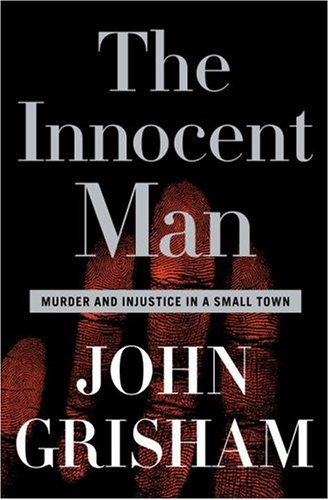
The Innocent Man


Just finished reading John Grisham's first nonfiction work and latest book, The Innocent Man. I highly recommend it to those who enjoy nonfiction that reads like fiction. I am reminded of my favorite author Truman Capote's In Cold Blood.

The Innocent Man tells the story of a man sentenced to death for a crime he did not commit. Grisham said he was simply flipping through the newspaper when an obituary caught his attention..."Ronald Williamson, Freed from Death Row, Dies at 51."

Wrote Grisham: "I read it the second time. Not in my most creative moment could I conjure up a story as rich and as layered as Ron's. And, as I would soon learn, the obituary barely scratched the surface....Writing nonfiction has seldom crossed my mind--I've had far too much fun with the novels--and I had no idea what I was getting into."

More than the lessons about capital punishment and injustice, reading the book made one thing clear - real life is so much more colorful than fiction.

Tuesday, December 19, 2006

independent living

Let me share with you the story of my best friend, Joon. I met him many years ago in JASMS. We were in sixth grade then. We started as enemies. I considered him the kind of classmate whom you get very pissed at for no particular reason. Years passed, however, and we became really good friends. We filled each other's younger days -- from the clubs, parties, concerts (we rocked with the Pearl Jam) to the sentimental heartbroken episodes that each of us went through. It was the kind of friendship that made one forget the passing of time, the curfews and the ticking of the wee hours of the morning.

Something changed, however, not too long ago. Joon met an accident one fateful day in 1998. He is now paralyzed from the neck downwards, pinned to the bed 24/7 because the accident killed more than half of his body. He needs at least two people to sit him on a wheel chair and always, at least one person to help him do the simplest things -- turning on the computer, preparing his meal, grooming his hair, brushing his teeth and even smoking. He can no longer do things on his own.

But despite all this, I never saw Joon -- not once -- bear a disabled being's soul. He remains the strong, forceful individual that I know.

And he continues to live life to the fullest, trying the best he could to live independently. But he needs help. He is inviting us to help him and others in similar situations in whatever way we can.

Read on:

Dear Sir/Madam,

The Life Haven, Inc. (LHI) is a non-profit organization with a mission to establish Independent Living Centers in the Philippines in order to promote the Independent Living Philosophy. The Independent Living Philosophy started in the USA in the early 70’s. The ideology of independent living is to inculcate in persons with severe/non severe disability/disabilities a sense of value of getting over and adapting to our disabilities and to be independent by practicing self-choice, self-determination and self-responsibility.

The Independent Living Concept was introduced to the Philippines by the Human Care Association of Tokyo. Members of Life Haven, Inc. have attended seminars and had undergone intensive training regarding the Independent Living Philosophy.

One of the services provided by an Independent Living Center is Peer Counseling, a service that aims to restore the sense of self-worth and re-establish the self-confidence of a person with disability (PWD).

In this regard, LHI will conduct a series of peer counseling seminars and workshops to empower fellow persons with disabilities with the concepts of independent living and the services of peer counseling for us to become service providers to other persons with disabilities instead of being just merely its recipient.

In this light, we would like to solicit for your kind support in whatever contribution payable to Life Haven, Inc. to help us defray the expenses in the implementation of this worthy undertaking. Help us realize our objective to enhance self-acceptance and dignity of persons with disabilities and help us live more independently in a manner dictated by our abilities, not our limitations.

One last request. Please forward this email to your friends and relatives for they also might want to help in this endeavor of ours. We will greatly appreciate this simple gesture.
Thank you very much and we highly anticipate your favorable response regarding this matter.

Very truly yours,

Joon G. Baltazar, Jr.
Public Relations Officer


Noted by:
Abner N. Manlapaz
President, Life Haven Inc.
Board Member, AKAP-PINOY
Council Member, National Anti-Poverty Commission (NAPC) - PWD Sector
Chairman, Independent Living Committee of NAPC – PWD Sector
Tel. Nos.: +63 2 4569819/ +63 928 2769513

Life Haven Incorporated is an organization duly registered at the Securities and Exchange Commission on July 7th, 2005 with Company Registration Number CN200511789
For your donations:

For donors in the Philippines
Please deposit your donations in favor of:
Account name: LIFE HAVEN INC.
Account number: 590078348
BANCO de ORO, Potrero-Malabon

Friday, December 1, 2006

Farewell, dear Gov

He was valiant to the end, much like a runner triumphantly rounding the homestretch after a fruitful life that included a successful stint as the country's top banking regulator.

Former Bangko Sentral ng Pilipinas (BSP) Rafael Carlos B. Buenaventura passed away at 3:10 p.m. yesterday at the Asian Hospital in Muntinlupa City after a falling into a coma, said his wife, artist Ma. Victoria Rufino who was with him.

"He passed away peacefully at 3:10 p.m. because of cardiac arrest due to complications," she said yesterday.

His remains were to be cremated last night. A novena mass will be held today (Dec. 1) at 6 p.m at the Santuario de San Antonio church in Forbes Park, Makati.

The 68-year old Mr. Buenaventura, who was born in San Fernando, La Union, on August 5, 1938, served as BSP governor from 1999 to 2005.

During his stint, he managed to keep monetary policy and the banking sector stable despite facing one of the toughest political transitions in the country's history.

Gov."Paeng" as he is fondly called by family and friends, emerged as one of the most colorful personalities in banking.

He implemented much-needed reforms in the sector and saw the Philippine central bank through one of the toughest times in the country including the impeachment trial of former president Joseph E. Estrada.

Mr. Buenaventura considered his biggest achievement as laying down the foundation for microfinance banking.

"I like to think that microfinance is my most important contribution," he said in an interview back in 2004.

He has become so passionate with Bangko Sentral's microfinance initiatives that reporters covering the beat during his time have become so used to the topic.

In fact, reporters would jokingly close their notebooks when the amiable governor starts talking about his latest microfinance initiatives.

But people aspiring to put up small businesses can only thank him for his legacy. Since Mr. Buenaventura introduced microfinance initiatives, the number of banks engaged in small-scale, collateral-free lending has risen to 132 from only 20 in 1999.

Mr. Buenaventura encouraged banks to engage in microfinance lending by having the central bank provide incentives for those venturing into the business.

The former Citibanker also counts as an achievement the central bank's shift to the so-called inflation-targetting method of setting monetary policy.

Local and international business circles recognized his successful term but it was the recognition fromthe prestigious New York-based Global Finance magazine that he is most proud of.

He was given a Grade A from 2002 and 2003, a feat that was difficult to achieve for a monetary chief in an emerging market like the Philippines.

Before being appointed as central bank chief, Mr. Buenaventura spent more than three decades in the private sector as head of PCIBank and regional treasurer of Citibank. He also headed the Bankers Association of the Philippines, the lobby group of local bankers.

He ended his stint at the BSP happy that President Gloria Macapagal-Arroyo appointed Amando M. Tetangco as his successor.

On the lighter side, Mr. Buenaventura is known for his sense of humor, his crisp barongs, well-combed hair and colorful ties.

Mr. Buenaventura is a proud Atenean, where he completed his secondary education.

After completing his high school education at the Ateneo, Mr. Buenaventura studied at the De La Salle University, where he received a bachelor's degree in commerce.

He completed a master’s degree in business administration at the Stern School of Business of the New York University in the United States.

(A shorter version of this article was published in BusinessWorld on Dec. 1; photo from news.bbc.co.uk).

I covered Gov. Paeng for two years when I was assigned to cover the central bank beat in 2004. I didn't like him at first because I felt like he only wanted to talk to the veterans but I would later earn his trust.

I learned a lot from this man, a sweet, charming, brilliant and well-respected government official. Although there were times when I felt like he was still wearing a bankers' hat while at the central bank, the policies that he pushed proved otherwise.

"Chances favor a prepared man," he likes to tell reporters. I never forgot that piece of advice since then.

The last time I talked to him was in September when I apologized for missing his dinner invitation. He was charming and amiable as always. He said we'd see each other again. That was, however, the last time I would talk to him.

Farewell, dear Gov.